FCC Part 20 & Part 90NFPA 72 / IFC 510 ERRCSLicensed low-voltage & insured
Mon–Fri 7a–6p CTFree RF site survey
Design · Step one on every commercial deployment
RF Site Survey & Benchmarking
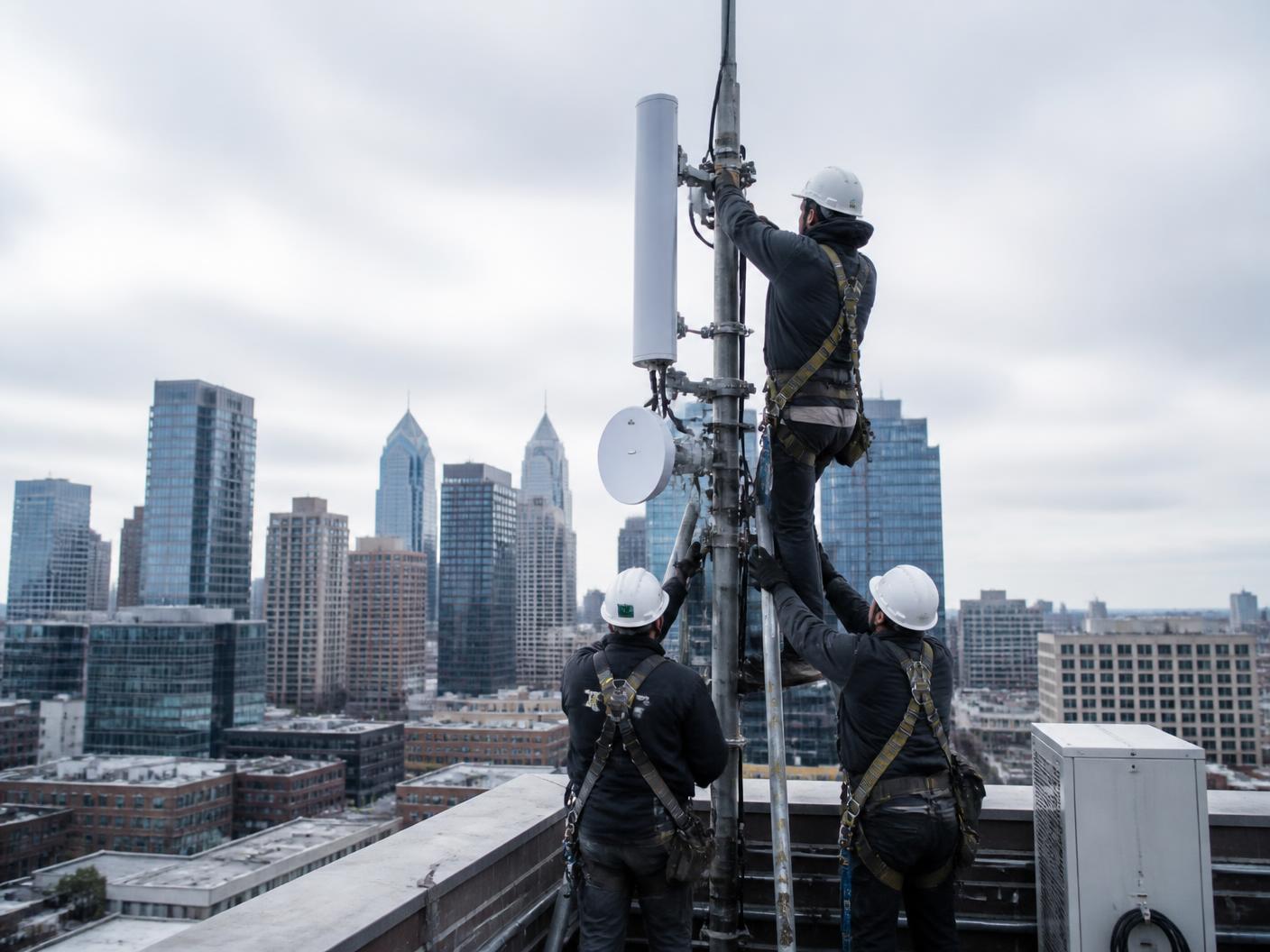
Every engineered system starts with measured data, not a guess. We benchmark outdoor RSRP/SINR per carrier at the roofline and walk the interior with calibrated scanners to map every dead zone, floor by floor.
On-site time
4–8 hours typical
Turnaround
3–5 business days
Cost
Free for qualified commercial buildings
Coverage
10,000 – 500,000+ sq ft
Straight answers
What it is, what it costs, whether you need it.
Most people land here after months of dropped calls, or because a design/build team asked for proof that a system is even needed.
No gated pricing, no “contact us for a quote” on the basics. Every number below is the range we actually quote in commercial buildings; your survey replaces it with a fixed figure.
What is an RF site survey, in plain English?
An engineer measures the actual cell signal outside your building and inside every area of it, using calibrated equipment instead of a phone's signal bars. You get a map showing exactly where coverage fails, how strong the usable signal is on the roof, and whether a booster system can legally and physically fix it.
What does it cost?
For qualified commercial buildings we survey at no charge — the cost is folded into the project if you proceed. Standalone third-party surveys in this market typically run $0.02–$0.10 per sq ft, or $1,500–$6,000 for a single building.
Do I need one before buying anything?
Yes. An off-air booster amplifies signal that already exists outside your building. If the rooftop benchmark is too weak, no amount of hardware fixes it — you need an active DAS or a carrier signal source. The survey is what keeps you from buying the wrong system.
This is the right scope if
- Staff report dead zones but nobody has measured them
- You've been quoted a system without anyone visiting the site
- A GC or landlord needs documentation before approving spend
- You're comparing bids and need one apples-to-apples scope
We’ll point you elsewhere if
- You already hold a current survey — send it and we'll price against it
- Your issue is Wi-Fi or wired network, not cellular
What this covers
How the scope actually runs.
Our engineers record donor signal strength and quality for AT&T, Verizon, T-Mobile, Dish and FirstNet at the proposed antenna location, then confirm the tower azimuth and whether the rooftop benchmark can support an off-air passive system at all. If it cannot, we say so before you spend anything.
Inside the building we run a gridded walk test on every floor, level and below-grade area, logging dBm readings against a floor plan. That produces a before heat map, a documented dead-zone inventory, and the link budget inputs needed to size antennas, splitters and cable runs accurately.
The survey output is a fixed-price design proposal — not a range. Building owners use it to justify capital, GCs use it to coordinate trades, and AHJs use the public-safety portion of it to scope ERRCS requirements.
Deliverables
- Per-carrier rooftop donor benchmark
- Interior dBm heat map, every floor
- Dead-zone inventory with photos
- System class recommendation
- Fixed-price scope and equipment list
Best fit for
- New construction turnover
- Buildings failing occupancy radio tests
- Tenants with SLA coverage clauses
- Multi-site portfolio audits
How we deliver it
Four stages, documented at every hand-off.
01
Scoping call
Square footage, floor count, construction type, carriers in use and known dead zones.
02
Rooftop benchmark
Per-carrier RSRP/SINR readings at the proposed donor location with calibrated scanners.
03
Interior walk test
Gridded dBm readings on every floor, stairwell, dock and below-grade level.
04
Design package
Heat maps, dead-zone inventory, system class recommendation and fixed-price scope.
Scope of work
Exactly what's in — and what isn't.
Included
- Per-carrier donor benchmark on the roof
- Gridded interior walk test with logged dBm
- Before heat map by floor
- Public safety pre-test against IFC 510 grid
- Fixed-price engineered proposal
Not included
- Structural or electrical engineering
- Wi-Fi or LAN assessment
- Residential or vehicle systems
Codes & standards
Executed against published standards.
FCC Part 20
Consumer/industrial signal booster certification and carrier consent.
FCC Part 90
Part 90 Class A/B signal boosters for public safety spectrum.
NFPA 72 / 1225
Emergency responder communication enhancement system requirements.
IFC 510
In-building emergency responder radio coverage, adopted by your AHJ.
NEC / NFPA 70
Low-voltage pathway, plenum cabling and grounding requirements.
Investment
Budget ranges, stated openly.
Qualified commercial buildings
No charge
10,000+ sq ft with decision-maker on site
Documentation-only survey
$1,500 – $4,500
When you need the data without our install
Turnaround
3–5 business days
From walk-test completion to delivered package
Ranges reflect turnkey commercial work in our markets. Your survey returns a fixed-price number, not a range.
Platforms
- WilsonPro Enterprise 1300R / 4300R
- Nextivity Cel-Fi QUATRA 4000e
- SureCall Force8 / Guardian4
- ADRF SOLID public safety BDA
- Comba CriticalPoint ERRCS
- Corning Everon fiber DAS
Platform-neutral — we spec whatever the RF budget calls for.
Where we deliver it
RF Site Survey & Benchmarking — available in these markets
Engineered and dispatched from our Houston office. Multi-site portfolios handled nationwide.
Answers
Asked about this service
Does the site survey cost anything?+
For qualified commercial buildings the initial RF site survey and benchmark report are free. Large campuses and multi-building portfolios are quoted per site.
What if there is no usable signal outside the building?+
An off-air booster amplifies existing outdoor signal. If the rooftop benchmark is too weak or too noisy, we tell you during the survey and scope an active/fiber DAS or a carrier small cell path instead.
Related services
Installation
Passive DAS & Signal Booster Installation
FCC-certified off-air bi-directional amplifier systems covering every carrier at once.
View service
Compliance
Public Safety ERRCS / BDA Systems
NFPA 72 and IFC 510 emergency responder radio coverage engineered for AHJ sign-off.
View service
Installation
Commissioning & Walk-Test Certification
Gain balancing, oscillation checks and a documented before/after coverage report.
View service
RF Site Survey & Benchmarking — scoped this week
Send the building details and we return a scoped estimate in two business days.