FCC Part 20 & Part 90NFPA 72 / IFC 510 ERRCSLicensed low-voltage & insured
Mon–Fri 7a–6p CTFree RF site survey
Installation · Our most deployed commercial system
Passive DAS & Signal Booster Installation
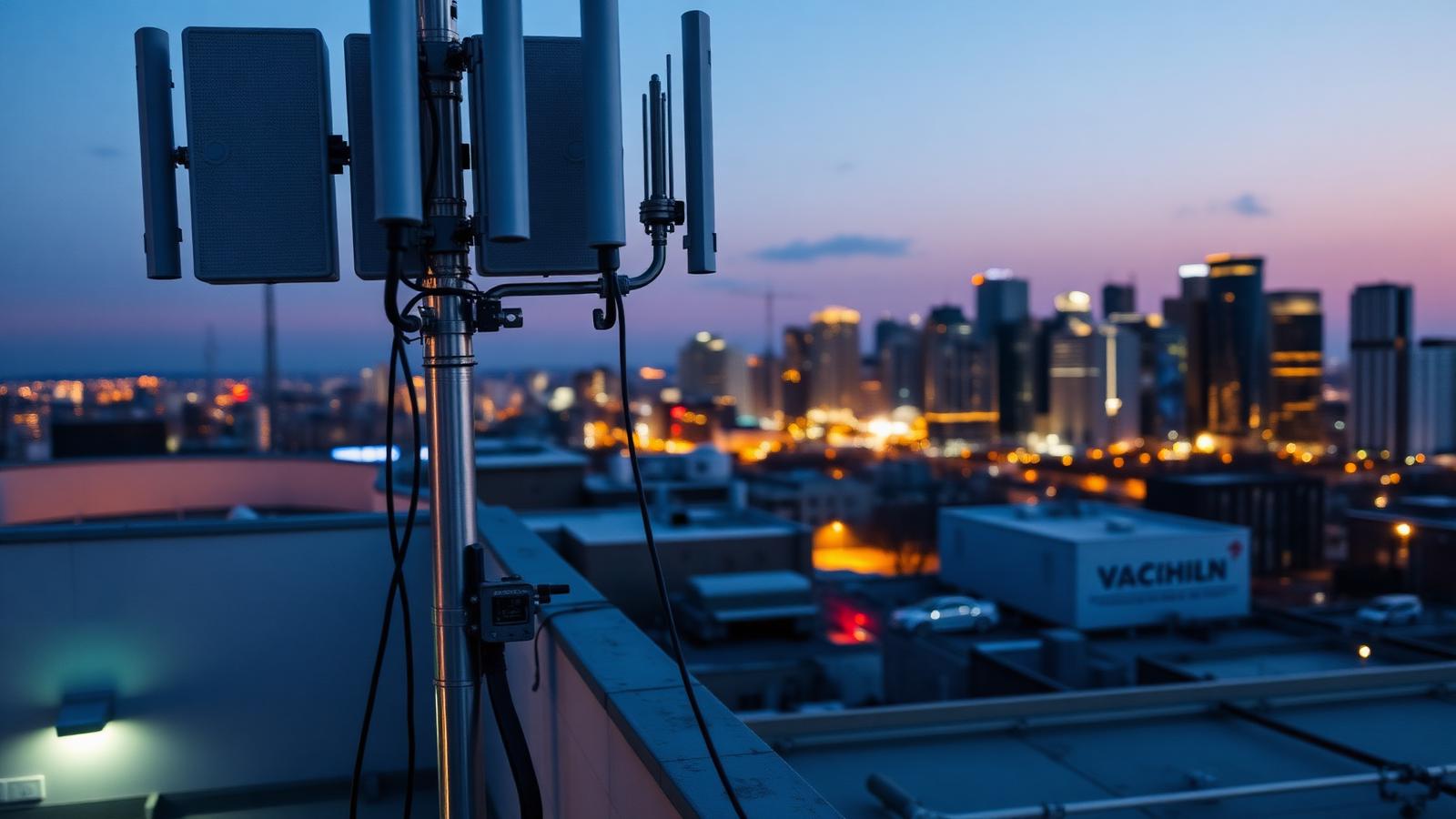
A rooftop donor antenna feeds an FCC Part 20 certified bi-directional amplifier that redistributes every carrier through a coax network of ceiling domes and panel antennas. No carrier base station, no monthly airtime, no recurring backhaul.
Building size
10,000 – 500,000+ sq ft
Installed cost
$1.50 – $3.00 / sq ft
Timeline
3–6 weeks
Recurring fees
None
Straight answers
What it is, what it costs, whether you need it.
Buyers reach this page comparing 'commercial cell phone signal booster' options against a full DAS, usually with a budget number in mind.
No gated pricing, no “contact us for a quote” on the basics. Every number below is the range we actually quote in commercial buildings; your survey replaces it with a fixed figure.
What is a passive DAS / commercial signal booster?
A rooftop antenna captures the strongest existing carrier signal, an FCC-certified bi-directional amplifier boosts it, and a network of coax and ceiling antennas redistributes it through the building. One system covers every carrier at once. There is no carrier equipment, no SIM, no monthly fee.
What does it cost?
Turnkey commercial installs typically land between $1.50 and $3.00 per sq ft — roughly $75k–$150k for a 50,000 sq ft building — including survey, engineering, hardware, licensed install, commissioning and documentation. Pricing moves with ceiling height, construction materials, floor count and how much of the work is after hours.
How long does it take?
Three to six weeks from signed scope to certified walk test for most buildings. Carrier consent filing, where required, runs in parallel and does not usually extend the schedule.
This is the right scope if
- 10,000 – 500,000 sq ft commercial building
- Usable carrier signal exists at the roofline
- You need coverage, not added network capacity
- You want a capital purchase with no recurring fees
We’ll point you elsewhere if
- The building is a stadium or dense venue needing capacity — see active DAS
- No usable donor signal on the roof — see active/fiber DAS
- You need emergency responder radio coverage — that's a separate ERRCS system
What this covers
How the scope actually runs.
Passive distributed antenna systems are the right answer for the overwhelming majority of commercial buildings between 10,000 and 500,000 sq ft. One head-end serves all carriers simultaneously, the hardware is a capital purchase, and a typical deployment runs three to six weeks from signed scope to certified walk test.
We design to the link budget, not to a kit. Antenna count, splitter topology, cable type and amplifier gain are derived from your survey data, then installed by our own licensed low-voltage crews using plenum-rated cabling, proper grounding and surge protection at the roof penetration.
Systems are built on proven platforms — WilsonPro Enterprise, SureCall Force8, Nextivity Cel-Fi QUATRA — and we stay platform-neutral so the RF budget picks the hardware, not a distributor relationship.
Deliverables
- Rooftop donor antenna and grounded penetration
- FCC-certified BDA head-end in a locked rack
- Zoned coax distribution and interior antennas
- Gain balancing and oscillation verification
- As-builts, walk-test report and 2-year warranty
Best fit for
- Warehouses and distribution centers
- High-rise and multi-tenant office
- Manufacturing plants
- Hotels and conference space
How we deliver it
Four stages, documented at every hand-off.
01
Survey & design
Link budget, antenna placement, cable schedule and predicted coverage plot.
02
Carrier consent
Part 20 registration and operator consent filed before energizing.
03
Installation
Donor antenna, head-end amplifier, riser and horizontal coax, ceiling domes and panels.
04
Commission & certify
Gain balancing, oscillation checks, walk test and signed after heat maps.
Scope of work
Exactly what's in — and what isn't.
Included
- Rooftop donor antenna and mount
- FCC-certified bi-directional amplifier head end
- Plenum-rated coax, splitters, taps and antennas
- Lift work, after-hours scheduling, GC coordination
- Commissioning report and 2-year hardware warranty
Not included
- Added network capacity (coverage systems do not add capacity)
- Carrier small cell backhaul
- Structural roof modifications
Codes & standards
Executed against published standards.
FCC Part 20
Consumer/industrial signal booster certification and carrier consent.
FCC Part 90
Part 90 Class A/B signal boosters for public safety spectrum.
NFPA 72 / 1225
Emergency responder communication enhancement system requirements.
IFC 510
In-building emergency responder radio coverage, adopted by your AHJ.
NEC / NFPA 70
Low-voltage pathway, plenum cabling and grounding requirements.
Investment
Budget ranges, stated openly.
Typical installed cost
$1.50 – $3.00 / sq ft
Turnkey, all materials and labor
Deployment window
3–6 weeks
From signed scope to commissioned system
Recurring cost
$0
No monthly fees, no carrier backhaul
Ranges reflect turnkey commercial work in our markets. Your survey returns a fixed-price number, not a range.
Platforms
- WilsonPro Enterprise 1300R / 4300R
- Nextivity Cel-Fi QUATRA 4000e
- SureCall Force8 / Guardian4
- ADRF SOLID public safety BDA
- Comba CriticalPoint ERRCS
- Corning Everon fiber DAS
Platform-neutral — we spec whatever the RF budget calls for.
Where we deliver it
Passive DAS & Signal Booster Installation — available in these markets
Engineered and dispatched from our Houston office. Multi-site portfolios handled nationwide.
Answers
Asked about this service
Does a passive DAS add capacity?+
No. Off-air passive systems improve coverage, not capacity. If a building needs added capacity — a stadium or a very dense venue — we scope an active DAS with a carrier signal source.
Do we need carrier approval?+
Where FCC Part 20 requires it, we file and manage consent with AT&T, Verizon, T-Mobile, Dish and FirstNet on your behalf as part of the deployment.
Related services
Design
RF Site Survey & Benchmarking
Calibrated per-carrier signal mapping before a dollar of capital is committed.
View service
Design
Active & Hybrid Fiber DAS
Fiber-fed remote units for campuses, very large footprints and multi-building sites.
View service
Compliance
Carrier Approval & FCC Compliance
Part 20 consent filings, Part 90 licensing coordination and documented compliance.
View service
Passive DAS & Signal Booster Installation — scoped this week
Send the building details and we return a scoped estimate in two business days.